


Review: Nicki Germaine's photo book 'Springsteen: Liberty Hall' is a literal treasure

Updated: Nov 21, 2023

When it comes to “Springsteen: Liberty Hall” — Nicki Germaine’s stunning book of photos capturing a nascent E Street Band at the 400-seat theater Bruce would later memorialize in the lyrics of “This Hard Land” — I don’t think I could sum it up better than Max Weinberg: “From the first picture I felt like I was breaking into Tutankhamen’s tomb and finding the treasure.”
At the time Germaine took the shots captured in this volume — March of 1974 — Weinberg was still about half-a-year away from taking his place behind the E Street Band’s drum kit. The prior iteration, featuring Ernest "Boom" Carter on drums and Roy Bittan’s predecessor David Sancious on keyboards, has always felt sparsely documented … until now, that is.
Robert Santelli, executive director of the Bruce Springsteen Archives and Center for American Music at Monmouth University, sets the scene well in the book’s introductory essay, noting that “with three African Americans in the band, Carter, [Clarence] Clemons, and Sancious, Springsteen had one of the most integrated rock bands in America — soon to be one of the tightest.” It was a fascinating period for the band, and having this unexpected opportunity to revisit it is nothing short of thrilling.
The book starts with an introduction from Bruce himself, who notes that “no one knew who the photographer, Nicki Germaine, was, but in those days that did not disqualify you from getting close to the band.” And boy, did she ever. At 26, she was clearly still developing as a photographer — she had studied photography at the University of Texas at Austin, and was working for a commercial photographer in Houston, according to Santelli's essay — and some of the performance shots have the fuzzy feel of a shooter still feeling her way. Fortunately, the band was in the same position, and the rough-hewn images seem perfectly appropriate for capturing that stage of their existence.
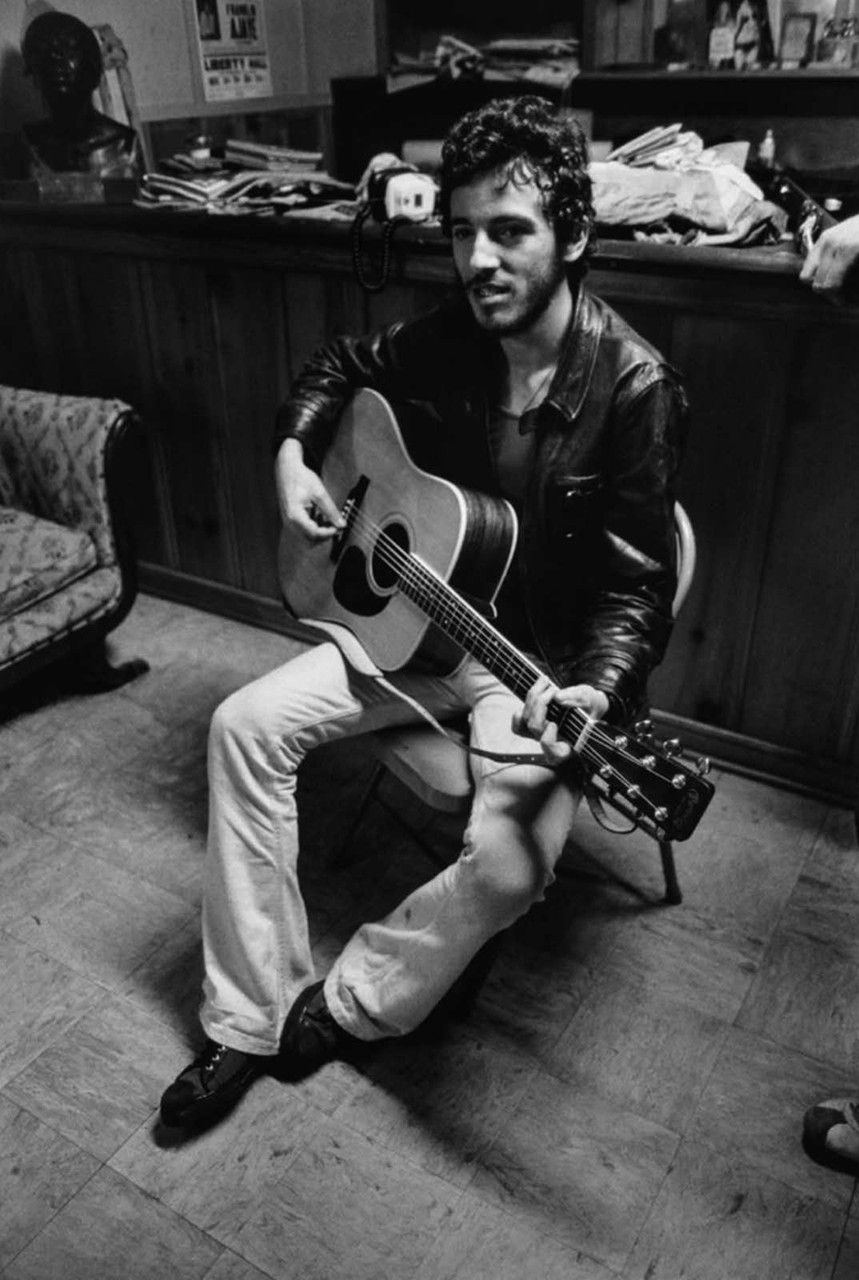
More polished — and in many cases dazzling — are the portraits and candids she got permission to take during the day, “giving Germaine the opportunity to capture the kind of moments that few, if any, photographers had gotten prior to Liberty Hall,” Santelli notes. We see in one photo a skinny, shirtless, bearded Bruce looking into the distance, holding a Coke with ice, and in another strumming his guitar next to a beat-up case in what looks like an impromptu rehearsal; the shots, like so many in “Springsteen; Liberty Hall,” seem both incredibly natural and intimate.
There are beautiful black-and-white portraits of the band members, too: Sancious, deep in thought; a relaxed Clemons, sax on his lap, throwing a sly look almost over his shoulder; Danny Federici, hands clasped and leaning on what may be a piano; looking like he’s up to trouble; an open-faced Garry Tallent, in all his long-haired, cowboy-shirted glory.
As for presentation, I can’t overstate just how gorgeous the book is: A 10x13-inch hardcover printed on heavy stock, it has the feel of an upscale yearbook that further elevates the material within. The photos are vital and dynamic, the wider shots awash in detail and the close-ups simply popping off the page. (One caveat: You’ll have to flip to a plates directory in the back for the captions.)

The photos are well complemented by the essays, both Springsteen’s and Santelli's, and an especially lively one from Garry Tallent, including a story about getting into an almost-altercation with a drunk on the train on the way to Houston. (“At that point Clarence had taken the drunk guy in the baggage car, and was about to beat him up,” is part of the tale.) It was Tallent whose interest sparked the project, after he contacted Germaine in 2011 inquiring about Liberty Hall photos for a piece someone was writing about him.
“Shortly thereafter, Garry contacted me and said, ‘Nicki, you have something with these! We don’t have anything like this!,’” Germaine writes in an epilogue explaining the book’s fruition, which began when she was still finishing a long career in real estate. She might have left professional photography behind, but looking at these photos it’s clear Tallent was right: She had something. (And if getting these photos out of the vault and into the public eye wasn’t enough of a happy ending, here’s another: Tallent and Germaine got together as well, and they seem adorable.)
“Moving out of the minor leagues and into the majors,” is how Bruce describes that stage of their career in one quote from the book. “Liberty Hall and the shows that followed marked the beginning of a real turning point.” And thanks to “Springsteen: Liberty Hall,” we can feel like we were right there with them, making the turn.
For additional information and to order, visit springsteenlibertyhall.com.

I can see why connecting values with everyday school life would invite discussion, since different people will bring different experiences to the same question. Kindness becomes easier to understand when it appears in ordinary classroom situations. It makes me curious about the practical side of values based education. I can imagine different answers depending on the situation, so I would want to understand the context before drawing conclusions. How can a school discuss values while leaving room for students' questions?
A conversation about choosing learning resources for different needs seems most useful to me when it leaves space for uncertainty and further questions. The same explanation can feel clear to one learner and confusing to another. That is the kind of detail I would keep in mind while exploring educational learning resources. I am more curious about the process than a polished result, because the steps in between are usually where questions appear. What clues help you choose a resource that matches a learner's starting point?
My first thought about making room for neighbourhood learning activities is that the everyday experience deserves as much attention as the larger explanation. A familiar local meeting place can make trying a new activity feel more approachable. For me, that is a useful way into the broader subject of community learning activities. A short discussion of an everyday example would make this easier for me to connect with, especially as someone still learning about the subject. What would encourage someone to join a class for the first time?
There is something approachable about discussing returning to learning as an adult through situations people can actually picture. A flexible pace can help learners fit study around work and family responsibilities. That connection helps me see why adult continuing education can be worth a closer look. The part I would like to explore further is what happens when the idea meets a real situation with its own limitations. What support makes returning to education less daunting after a long break?
What draws my attention to understanding biometric identity and privacy is the possibility of making an unfamiliar subject feel closer to everyday life. Convenience deserves to be considered alongside how identifying information is collected and stored. That is the kind of detail I would keep in mind while exploring biometric data privacy. I can imagine different answers depending on the situation, so I would want to understand the context before drawing conclusions. What questions should a beginner ask before trusting a biometric system?